Showing posts with label Books. Show all posts

Tuesday, June 12, 2018

STRESS BUSTER

WHAT TO WATCH


THE BIG SICK:


Kumail is a Pakistani origin Stand-up Comedian living in Chicago. At one of his shows, he meets Beth and they hit off right away. Soon, they start dating but meanwhile, Kumail’s parents led by his father (Anumpam Kher) keep introducing him to Pakistani girls, with the aim to get him married in accordance with their tradition of “arranged marriage”, which Kumail is strictly opposed to. He hesitates to tell his family about Beth because his cousin was kicked out of the family for marrying a “white” girl. On learning this, Beth decides to leave Kumail.

Image result for the big sick review

Things turn upside down as Beth falls sick and is medically induced into a coma. Kumail, now finds himself trying to form a bond with Beth’s parents as Beth fights for her life, while also dealing with his parent’s whims and trying to pursue a career in stand-up comedy.

The movie takes rom-coms to another dimension. It is witty, humorous and strikes a chord or two with the viewer as Kumail tries to fight battles on multiple fronts at the same time.

Will he succeed?


WHAT TO READ


THE THRILLING ADVENTURES OF LOVELACE AND BABBAGE:


Image result for the thrilling adventures of lovelace and babbage review

Do not judge the book by its name! If you think we are talking science fiction, you could not have been more mistaken. A graphic novel of the highest quality, it is a book not meant to be read, but to be reread.

The book presents an alternate universe in which Lovelace and Babbage successfully build a Difference Engine and use it to solve real-world problems.

This graphic novel allows the reader to escape by going back in time into an alternate future that's captivating and engrossing. Sydney Padua captures one of the most compelling scientific collaborations in a series of hilarious adventures.

Tuesday, May 29, 2018

SUMMER BUCKET 4.0

WHAT TO WATCH

INSIDE OUT:

Simply put, a dazzlingly imaginative adventure set inside the mind of an 11 year old girl. Inside Out is a formidably ingenious film set which hits an elusive sweet spot in appealing to adults and children alike. It's in the way that the story depicts the fading of childhood's mental furniture, and explores the mechanics of forgetting, that Inside Out achieves a universal significance. The running gags are delicious and the movie expertly tugs the heartstrings. Don't be afraid to wipe a tear from your eye at the end of it.

Image result for inside out


WHAT TO READ


Dear Ijeawele or A Feminist Manifesto in Fifteen Suggestions:


It would be very difficult not to like this little book which shines with warmth and forthrightness. The author Chimamanda Ngozi Adichie's friend Ijeawele wrote to ask how she should bring her baby daughter up as a feminist, and in response, Adichie made a list of fifteen suggestions. Some of the suggestions are mountains of difficulty made simple which burrow down into the heart of the matter. It will start a new and urgently needed conversation about what it really means to be woman today.

Image result for dear ijeawele or a feminist manifesto in fifteen suggestions review


Monday, May 11, 2015

The Old Kingdom Trilogy by Garth Nix.


From the time I started reading, I've always been partial to Fantasy as a genre. Reading about worlds that could never be, and being transported to entire universes that authors create out of practically nothing, books on fantasy and science fiction were a means to escape the reality I lived in. And though there are a great many books and series that you could classify as fantasy, only a handful of them have a world so coherent, so well built, and a storyline so captivating, that you just can't stop yourself from going back and reading them again. The Old Kingdom Trilogy by Garth Nix is, in my opinion, one such series.

Garth Nix is an amazing author based in Australia. I stumbled upon another one of his series in my school library, and from there went on to read a lot of what he's written. And it almost never disappoints. Yes, he is primarily an author who focuses on YA fiction, But the Old Kingdom is an attempt to go beyond that. And it sure does.

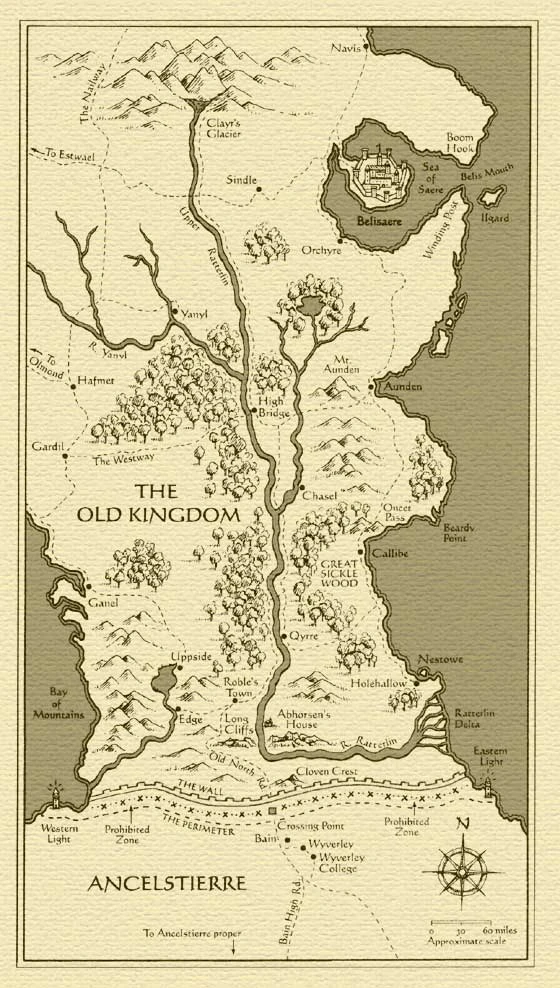
The books - Sabriel, Lirael, and Abhorsen - are all set in a small, parallel world, and as it is with most books in the genre, it begins with a map ( A little background would help, I guess)


The two major regions where the story plays out are The Old Kingdom - the remnants of a long lost empire - and Ancelstierre - a place that resembles Britain in the 1930's. If you'd look closely at the map, You would see one of the things that this trilogy has in common with another, far more famous series. The two regions are separated by an enormous barrier called, for lack of a better term, "The Wall". On the side of Ancelstierre, there is a Border protection force that keeps things from over the wall, over the wall. And in case you haven't guessed already, there's magic involved. And dead spirits coming back to life. And a broken royal family on the verge of extinction. And Swords.


( not that one... )


Now, if you've already decided to never read this rip-off of a series, know this- Sabriel came out early 1995, while the other series (Fine, if you haven't got it already - A Song of Ice and Fire) started in mid-1996. 

The books revolve around the journeys of two central characters, Sabriel and Lirael. Its not one of epic proportions, but it is one that you'd be able to connect to - one of self discovery, of loss and survival. That's the thing about Garth Nix stories - all the ones I've read are connected by an all pervading sense of loss, a melancholy feel that calms you. I always associate books of his with rainy days and cups of steaming Horlicks. That's the kind of feeling the books leave you with ( at least, that's what I felt.. do tell me if you think otherwise) and its something I would definitely want you to try. There have been multiple side-stories published, and even a prequel to the trilogy ( 400 
years prior to it )- Clariel - that came out late last year. But it is the trilogy that actually matters ( though by all means, read the others, all of them are just as rewarding) .


The series builds up and maintains a steady pace throughout, and is filled with gems of characters, who although short-lived, leave a big impact on the story, one that talks about fate, mortality and the choices we have to make. If I had to pick one line from the series to sum it up, it would be the one that appears time an again, almost as if it were the central theme - 

"Does the walker choose the path, or the path the walker?"

 I'm not going to tell you anything significant about the plot, That's something you should have the pleasure of finding out yourself. If ever you get the time, and want a brief reprieve from this world we live in, the Old Kingdom is a place that's definitely worth visiting.

-Rishi Vanukuru.

Tuesday, December 16, 2014

Book Review: After Dark by Haruki Murakami

murakami-1-after-dark-even-at-a-time-like-this

This is a Murakami novel. Yes, apart from the obvious what it means is that there are certain things you ought to know before you begin, like:
1. It cannot be caged inside the mundane confines of a 'genre'; it is, in the vaguest of terms, a personal experience like any other, albeit an extremely strange one.
2. It will feature at least one erudite (and bibliophilic) person and one music aficionado, several oddballs whom you come to know are characters by the last-page and cats. Cats are an absolute must even if they aren’t centre-stage, just cameo.
3. It will rain metaphors and magical realisms. (Cataclysmic? You have no idea.)

Now that you are armed with sufficient knowledge, I'll tell you how it all begins:

It is after dark and to those few who are awake, time, as sluggish as never, moves towards that mark of midnight, a the hour-hand’s staccato schlep following the omniscient minute-hand. Soon it will be another day. And we have a lot of places to be, among darkness and time.

There is Mari Asai, sitting in a late-night restaurant in a seedy downtown entertainment district with a cup of tasteless coffee, seemingly absorbed in the huge book she has in front of her. There is the chance and quite an uninteresting encounter with her sister's friend, Tetsuya, a jazz trombonist. There is her sister herself, Eri Asai who is a gorgeous model, in a different place, in an eerie bedroom, asleep in the most unnatural and deepest of slumbers. There is a Man with No Face watching her beautiful body from the other side of an unplugged television screen. And in yet another place, a love hotel not far from where Mari is seated, there is an inconsolable, physically abused, Chinese prostitute.

You see, to you and me, these are a weird motley of people, people we hardly associate with. But what the author does here is this: he strips them of their outlandish facade, strips them down to the banalities of small-talk and awkward conversations; he lets us see them at the ungodly hours, these strangers who make us feel all-knowing and clueless at once; then he leaves us to predict how the threads of their lives might intertwine, only to later reveal that these aren't threads we can hope to untangle but rather tides that continuously coalesce, emerging from realms that we can't possibly imagine.

At this point, I must tell you that it is near to impossible to review this book objectively with a clean cut dissection and psycho-analysis of each 'character' and tell you 'how things happen' and 'what you should make of it'. For one, the characters are unlike what conventionality demands, they talk and they muse, that is all. They seem to be tools to convey philosophical musings, at best. Now what a reader makes of this fact is entirely up to him but since this is a very short book (at 201 pages) I preferred it this way. And under the mighty cover of the night, when rationality is somnolent and morality already inching towards invisibility, there are too many blurred lines and much less explanation offered. While on one hand it makes the aforementioned magical realism more acceptable to the reader and leaves a lot to his/her picturesque imagination, it also seems inadequate-like too many pieces are missing. The prose is simple yet eloquent and exudes surrealism, like many other things, and never disappoints:
“You know what I think?" she says. "That people's memories are maybe the fuel they burn to stay alive. Whether those memories have any actual importance or not, it doesn't matter as far as the maintenance of life is concerned. They're all just fuel. Advertising fillers in the newspaper, philosophy books, dirty pictures in a magazine, a bundle of ten-thousand-yen bills: when you feed 'em to the fire, they're all just paper. The fire isn't thinking 'Oh, this is Kant,' or 'Oh, this is the Yomiuri evening edition,' or 'Nice tits,' while it burns. To the fire, they're nothing but scraps of paper. It's the exact same thing. Important memories, not-so-important memories, totally useless memories: there's no distinction--they're all just fuel.”

Having read three of Murakami’s books in the last fortnight, I can safely say that even-though they all seem to share some similarities, these shared consistencies in no way imply predictability. If anything, one can be sure of what one is going to get out of the book and not be disappointed.  Recommendation, you ask? To those who desire a brief reprieve from the tedium of real life: pick the most peaceful and comfortable spot and spend some time with After Dark-with the unscrupulously seamless night, with Mari who suffers an identity crisis and with Tetsuya who’s unsure of his future, find yourself in their insecurities, their uncertainties and lose yourself in their words; and then walk back to the humdrum of everyday life, like you know a secret that the others don’t.

Contributed by Basuhi Ravi. 

Thursday, December 11, 2014

The Complete Maus- A Survivor's Tale by Art Spiegelman

The professor of my Language and Literature course had mentioned this one amongst her many references while teaching. The knowledge that we hadn’t read this graphic novel was immediately followed by a rebuke, and so I decided to read it. This was my first foray into the enormous world of graphic novels, and there’s nothing surprising in this book winning the Pulitzer Prize (being the only graphic novel with this distinction).
No suspense here: Maus (German for, well, ‘mouse’) is, as it says in the subtitle, is a Survivor’s Tale.  There’s nothing left to spoil. A ‘survivor’ in a story set in Nazi Germany can mean only one thing. There’s some good news in this. Written by Art Spiegelman, this is a story in two volumes of him interviewing his father, a Polish Jew, about his experiences during the rise and fall of Nazi Germany.
The plot here isn’t really the element that gives this book such significance. Of course, the experiences of a survivor of the Holocaust are pretty gripping on their own, but here, the narration takes over the actual story. This is a not just a survivor’s tale, but also one executed in the form of a graphic novel, a second-hand history and a highly self-referential story. However, I am not pointing it out as being unique as the only postmodernist work about the Holocaust and nor the most famous. There have also been some other famous non-conventional narratives: Anne Frank’s epistolary, for example.

One of the more offbeat features of the novel is the not-so-subtle metaphors used throughout the story. The Jews are all depicted as mice, the Germans as cats, the Poles as pigs and the Americans as dogs – quite a good review of racist stereotypes. This is no Animal Farm, though, as the animals are anthropomorphized, with the metaphor itself breaking down in many places throughout the novel. Mice-characters shown to be scared of mice; the author persona shown to be unsure about assigning animals to some characters; at the psychiatrist’s office there’re just mouse masks. Still, bringing in these traditionally ‘funny’ representations for such a grave plot is not only ironic in itself but also in the fact that it serves to humanize the characters in a way. You see the characters for who they are – their behavior, their ideas, their experiences, their horrors – instead of what they look like, but the racial tensions are still seen through.

Another way of humanization here is that the holocaust survivor – Art’s father – is not shown as an idealistic hero like survivors are often depicted, but as just another person, with his qualities and flaws on full display. The same happens with Art’s character himself, as he goes through his own struggles of dealing with a stubborn and miserly father, living up to his inner struggle as his parents’ ‘other’ son, and his post-war privilege, among other things. History, memory and the presence of the memory of the Holocaust story only as a second-person narrative serve as other major themes, especially in the second volume of the novel.
I don’t have much to say about the illustration, for this is the first graphic novel I’ve read, but I found this particular panel very, very outstanding: 
Overall, I would recommend this book being read as more as a personal memoir (on two levels) than just as a survivor’s tale. If you like historical novels (especially ones set in the World War Era), this is a must-read. A third-hand glance into the horrors of the Holocaust, and a first-hand glance into alternative methods of narrative are some of the things that this book provides, along with an honest portrayal of a person’s journey and experience through those times.      

Contributed by Mihir Bhosale.